

Written by Atty. Ara Hablero
Buying an unsurveyed land portion in the Philippines is legally risky even with a signed Deed of Sale. A Deed of Sale only proves a sale happened. Without a proper survey and technical description, it does not clearly prove which land was sold, where its boundaries are, or whether the seller actually owned what they showed you.
A seller with a large lot offers to sell a portion of it. The price looks right. The location feels correct. You shake hands, sign a Deed of Sale, pay the full amount, and consider yourself a landowner.
But what if that portion was never properly surveyed and technically described before you signed, you may have paid for something you cannot fully prove is yours.
This does not mean the transaction is void. It means the transaction is incomplete in a way that can produce serious problems years or even decades down the line, often after the original seller is no longer alive to clarify what was agreed.
“300 Square Meters at the Back” Is Not a Legal Description
Imagine Pedro owns a 2,000 square meter lot. He agrees to sell 300 square meters of it to Juan.
“I’ll sell you the 300 square meters at the back.” “From the mango tree over there…” “Up to the fence on that side…” “Beside the road…” “Just 300 square meters somewhere there.”
They execute a Deed of Sale. Juan pays in full. While Pedro is alive and the relationship is good, everything is fine.
But what happens ten or twenty years later?
Pedro is gone. Juan is now dealing with Pedro’s children and grandchildren. And they say:
“That’s not where the sold portion is. It’s on the other side.
This is where disputes begin. And without a proper survey, they are extraordinarily difficult to resolve.
“300 square meters” tells you only how large the parcel is. It says nothing about where exactly it is within the 2,000 square meter mother property. Without a technical description, boundaries, and measurements, the Deed of Sale is legally thin.
Where exactly are the boundaries? Not “from the tree to the fence” but actual geodetic coordinates and measurements.
What is the shape of the portion? A 300 square meter parcel can be long and narrow, square, L-shaped, or irregular. Shape affects usability and value.
What are the measurements of each side? Essential for fencing, construction planning, and eventual titling.
How does the buyer reach a public road? A landlocked portion with no defined access route is legally and practically problematic.
Does it overlap with any other sold portion? If the seller has sold multiple portions, overlaps are common without proper subdivision planning.
Does it fall entirely within the mother property? A portion that extends beyond the seller’s actual property boundaries creates immediate title problems.
HIGH RISK: Without a survey, there is no objective reference point for where the sold portion begins and ends.
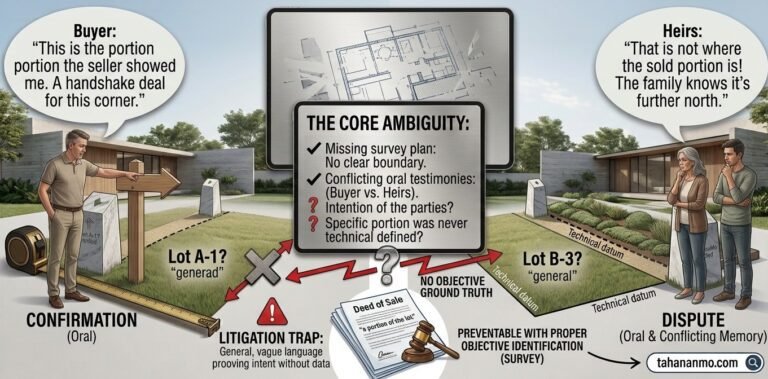
The buyer says: “This is what the seller showed me.“
The heirs say: “That is not where the sold portion is.”
Without a survey plan, sketch, boundary monuments, technical description, or any other objective identification of the portion, proving which claim is correct becomes extraordinarily difficult and expensive.
What should have been a simple title transfer becomes litigation.
AREA DISCREPANCY: A survey sometimes reveals the portion is smaller or larger than what the Deed of Sale states.
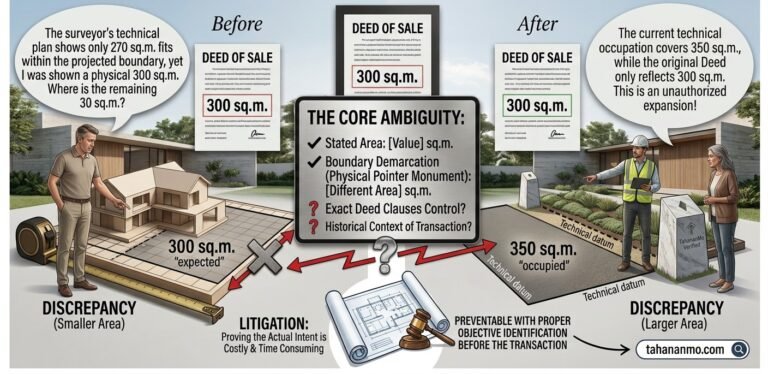
The Deed says 300 square meters. The actual survey reveals only 270 square meters fit within the boundaries that were shown. Or the buyer has actually occupied 350 square meters.
Then comes the harder question: which controls, the stated area in the Deed or the boundaries that were pointed out? The answer depends on the exact wording of the Deed of Sale and the circumstances of the transaction. This ambiguity is preventable. It is not preventable after the fact.
OVERLAP RISK: If the seller has sold portions to multiple buyers without a subdivision survey, overlaps are common.
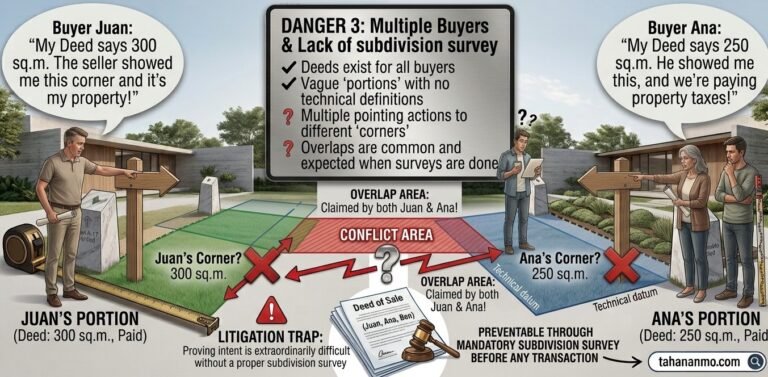
To Juan: 300 sq.m.
To Ana: 250 sq.m.
To Ben: 400 sq.m.
All have Deeds of Sale. All paid in full.
None had a survey done first. When a survey is finally conducted: the portions of Juan and Ana overlap.
Both buyers have valid-looking documents. Both paid legitimate consideration. Both were shown their portion by the same seller. Yet they are claiming the same land.
This situation, which is more common than most buyers realize, is entirely preventable through proper subdivision survey before the sale. It is nearly impossible to resolve cleanly after the fact without litigation.
LANDLOCKED RISK: A portion that has no defined road access route may be legally unusable regardless of valid ownership.
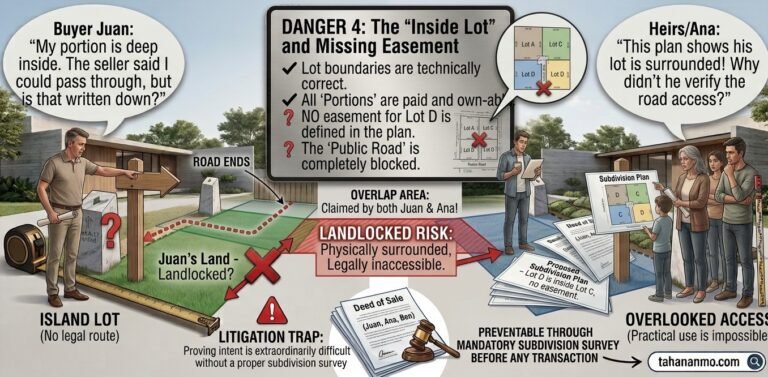
A portion priced attractively because it is “inside” the property may turn out to be surrounded on all sides by other lots after subdivision. Without a defined easement or road access incorporated into the subdivision plan, the buyer owns land they cannot practically reach.
This is one of the most overlooked aspects of portion purchases. It is not enough to check the area and the boundaries. You must verify the configuration of the proposed subdivision and where your specific portion sits relative to the public road.
TITLING DELAY: Paying in full and receiving a Deed of Sale for a portion does not mean you have a separate title. You may be waiting years.
For titled property, separating a portion from a mother title requires a subdivision survey, approval of the subdivision plan by the relevant authority, satisfaction of tax and other registration requirements, and the actual issuance of a new Transfer Certificate of Title covering only your portion.
Until this process is completed, your portion remains legally part of the mother title. This means that if the seller dies, incurs debts, faces legal judgments, or sells the mother property to a third party, your interest may be at risk even though you have paid in full and hold a Deed of Sale.
The longer this process is delayed, the more complications can arise: additional heirs, conflicting transactions, encumbrances annotated on the mother title, or changes in tax and regulatory requirements.
BOUNDARY ERROR: BOUNDARY ERROR The most serious risk: the seller may have shown you land that is not actually within their property.
This happens more often than you might expect. The seller believes their property extends to a certain fence, canal, tree, or road. They show the buyer a portion based on that belief. A relocation survey later reveals that the actual boundary of the seller’s property is several meters inside what was shown.
The buyer has paid for land that the seller did not own. The Deed of Sale covers land that is actually owned by an adjacent landowner. Resolving this situation requires either purchasing the overlap from the true owner or litigation.
This is why verbal boundary references, fences, trees, canals, and posts cannot substitute for a proper geodetic survey and relocation of property boundaries before purchase.
A Deed of Sale is important. It is the document that evidences the transaction and the parties’ agreement. But its legal strength is only as good as the clarity of what it describes.
A Deed of Sale that reads:
“A portion containing an area of 300 square meters, more or less, located within the property of the vendor…”
…without any further technical description, sketch plan, or attachment identifying exactly which 300 square meters is being sold, is legally thin. It proves that a sale happened. It does not clearly prove what was sold.
A properly documented portion sale references an approved survey plan or technical description that unambiguously identifies the specific portion sold within the larger mother property. The difference between these two documents can be the difference between a smooth title transfer and years of litigation.
If a seller tells you they have already sold portions of the same property to other buyers, your due diligence requirement increases significantly.
You need to know: where were the previous portions, how large were they, were they surveyed, and how much usable area remains that the seller can legally convey to you without overlapping what was already sold?
Finding out after you have paid that the portion shown to you was already sold to someone else is one of the most preventable property disasters in the Philippines. Prevention requires verification before payment, not after.
Before signing any document or releasing any payment for a land portion in the Philippines:
✔ Obtain and review the mother title or ownership documents. Confirm the seller is the registered owner.
✔ Confirm the exact location of the portion you are buying, not just verbal description but on paper with measurements.
✔ Identify the boundaries and dimensions of all four or more sides of your portion.
✔ Request a survey plan or sketch plan with technical description, and confirm it is accurate and appropriately prepared.
✔ Verify road access. Confirm your portion has a defined route to a public road.
✔ Review existing annotations on the title. Liens, mortgages, adverse claims, and lis pendens all affect your purchase.
✔ Identify previously sold portions. Know what has already been conveyed and confirm no overlap with your intended purchase.
✔ Understand the subdivision and titling process. Know what steps are needed after the sale to produce a separate title in your name and how long they typically take.
A geodetic survey of a residential land portion in the Philippines costs between PHP 10,000 and PHP 50,000 depending on the size, location, and complexity of the property. An attorney’s review of the title, deed, and related documents before signing costs a fraction of that.
A property dispute litigated before Philippine courts costs several hundred thousand pesos in attorney’s fees, takes 5 to 15 years to resolve, and frequently produces outcomes where neither party is fully satisfied.
The arithmetic is not complicated. Survey and verify before you buy. Do not litigate after.
Before you buy any portion of a larger Philippine property, you need to know both: how large and exactly where. A Deed of Sale without a proper survey and technical description answers only the first question. The second question is the one that determines whether your purchase is legally secure.

The Philippines' curated directory connecting homeowners, architects, interior designers, and property professionals who believe in the beauty of thoughtful living.
BLOG AND INSIGHTS